Middleware
Snappy supports middleware at two levels: global middleware applies to all endpoints and controller-specific middleware that runs only for targeted controllers.
Middleware is altering the $callbackValues both before the request reaches the application and after the response is generated. Details of $callbackvalues is explained in this page
ℹ️ NOTE
However, the records property within $callbackValues is available for modification since database fetch result already done.
Middleware works like layers of an onion skin that can be illustrated as follows:
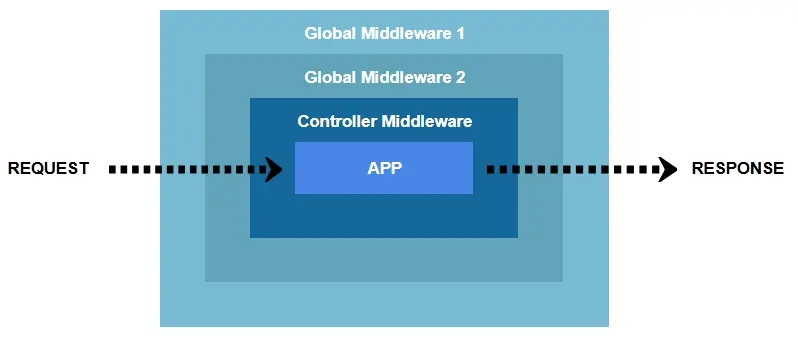
Creating middleware:
Manual
- Define
namespace Middleware - Define
use Core\Middleware - Create class name and extends your class from
Middleware - Save it with the same class name under middleware directory
CLI
php snappy generate middleware:YourMiddlewareName💡 Usage
get value from $callbackValues
$this::getData(string $key): mixed;key
A dot notation (e.g: data.name.last)
set value to $callbackValues
$this::setData(string $key, mixed $value): mixed;key
A dot notation (e.g: keys.last)
value
Value to be set
Snappy middleware requires corresponding request method -like Controller - to be executed
GET method handler
public function get(string $sequence): voidPOST method handler
public function post(string $sequence): voidDELETE method handler
public function delete(string $sequence): voidPUT method handler
public function put(string $sequence): voidPATCH method handler
public function patch(string $sequence): voidℹ️ NOTE
sequence value in middleware's request method only has before or after indicates before/after reaching controller
Global
Global middleware runs on all endpoints and suitable for Logger, Authentication and any process required for every request & response from the endpoint.
Example below related to $callbackValues explained in here
// middleware/yourmiddleware.php

namespace Middleware;
use Core\Middleware;

class YourMiddleware extends Middleware{
   public function get($sequence){
      if ($sequence == "before"){
        // change "last" parameter value of "keys" section to Wick
        $this::setData("keys.last", "Wick");
        //other logic before middleware reaches app
      }else{
        //other logic after middleware reaches app
      }
   }
}
Register your global middleware in config/middleware.php
return ["Middleware1", "Middleware2", "MiddlewareN"];Controller-specific
Controller-specific middleware in Snappy is designed to run only for a particular controller, giving you precise control over the request lifecycle and logic flow for specific endpoints.
Unlike global middleware that applies to all routes and controllers, controller-specific middleware is executed only when the associated controller is invoked. This is especially useful for applying logic like access control, validation, or transformation that's relevant only to a particular module or feature.
How It Works
To define a controller-specific middleware, simply create a file under the src/middleware/ directory that matches the controller file name, Snappy will automatically detect and execute this middleware when controller is accessed. For example, if you have a controller named Examples, the corresponding middleware file should be: src/middleware/examples.php
Usage:
// middleware/yourcontrollername.php

namespace Middleware;
use Core\Middleware;

class YourControllerName extends Middleware{
   public function get($sequence){
      if ($sequence == "before"){
          //do something before middleware reaches app
      }else{
         //do something after middleware reaches app
      }
   }
}
ℹ️ NOTE
No need to register your controller-specific middleware in config/middleware.php